2017 Holiday Gift Guide

Posted on 6:26 PM by Tina

This guide includes games for young and old, for every sex, generation, temperament, and culture.

Whatever you do, and whatever you celebrate, there is no better way to spend a Christmas, Hanukkah, or what have you than together with friends, family, and neighbors with a warm cup of (fair trade) cocoa and a stack of casual board and/or card games.

Remember that the most valuable gift you can give is time. Don't just give your loved ones a game; play it with them. Find or start a local game group and join or form a community.

I hope you enjoy the guide. Remember: the holidays are not only for sharing the warmth with family and friends, but also for sharing with those who have no one else to share with them. Give to your local shelters, hospitals, and so on, because that's the gift that keeps on giving.

Samsung Galaxy Tab 4 10"

Tablets are perfect platforms for playing thousands of face to face games for two to four players. Because you don't need to buy the physical components, you can stack all your games in a teeny space, the games (if not the tablet) cost very little, and you don't have to cut down old trees to make them or use fossil fuels to ship them. Tablets have their own environmental impact in their making, so that's a trade off; but if you're getting one anyway, most of the games on this list are available electronically.

Nowadays, most games are also available on consoles, too.
7 Wonders: Ages 9+, 4 to 7 players

This is a game of drafting cards and building a wondrous city. You get a hand of cards; pick one and pass the rest. Everyone reveals the card they picked and puts it into their tableaux. Repeat. Done. Score points based on the combinations of cards you have at the end of all the passing.

The graphics are fantastic, the theme not so visible. It's easy to learn, provides great choices, with depth enough to spare.

Antike II: Ages 8+, 2 to 6 players

Risk is a long game of laying low, with player elimination and just too much in the luck department; this game (and its predecessor but very rare and expensive Antike) is the perfect evolution to, and replacement for, Risk.

It plays quicker, there's dice-less conflict, no one gets to lay low watching while others fight, and - excepting truly poor play - everyone has a chance for most of the game. There's also a lot more to the game than just conflict, but the rules are short and elegant.

Other alternatives for the Risk player are Antike Duellum (for two players) and Risk Legacy (an odd game that moves in one game affect the next).

Backgammon: Ages 6+, 2 players

Backgammon is a classic game that can be enjoyed by children and parents alike. While there is a large amount of luck in the game, there are also many meaningful decisions, which makes this a good stepping stone to future games with more challenge, such as Checkers or Chess.
Blokus, Blokus Trigon, Blokus Duo: Ages 8+, 4 players (Blokus), 2-4 players (Blokus Trigon), or 2 players (Blokus Duo)

Blokus, Blokus Trigon, and Blokus Duo are abstract games with very simple rules. Each round you take a piece and place it on the board such that it touches any previous pieces you have played, but only corner to corner. It can touch other players' pieces along corners or sides.

The rules are easy, the components are beautiful, and it's fun.
Boggle: Ages 8+, 2 to 10 players

Boggle is a word game, whose simple rules - find all the words you can within three minutes - make it a game that is both fun and quick. Adults can play with kids by restricting the adults to have to find words of four or five letters.

The pictured version is a little quieter and less bulky than the old boxy version, and comes with a built-in electronic timer.
Candle Quest: Ages 6+, 2 to 4 players

A little plug for my own game. This is a simple set-collection auction game with a Hanukkah theme. It fits in well with the other games on the list: easy to learn, quick to play, lots of replayability. The theme makes it appropriate for all ages, and there's nothing overtly Jewish about it, other than that it's a menorah, so anyone should feel comfortable playing it.

Of course, I may be biased, since I designed it.
Carcassonne, variants, and expansions: Ages 10+, 2 to 5 players

Carcassonne is a bit more complex than some of the other games here, but the beautiful pieces and the fun game play are worth the time to learn. Pick a piece from the pile, rotate and place it so that it fits on the board (like dominoes), and then optionally place one of your pieces on that tile. There are several ways to score, some of which occur during the game and some of which only at the end of the game.

There are some more rules than that, but not too many more. The game play is engaging enough to make you want to play it more than once in a single sitting.

There are dozens of versions to the game, and some of the versions have several expansions.

Catan: Ages 8+, 3 to 4 players

This game, formerly known as The Settlers of Catan, and Ticket to Ride, are the perfect adult games for beginning gamers.

All you need to do is collect ten points through building settlements and cities, connecting roads, adding developments and trading with your fellow players. A unique board that changes each time you play, constant interaction even when it's not your turn, and a great balance of luck versus strategy makes this The Game to acquire if you still think that board games are only for kids.

Chess / Xiangqi / Shogi: Ages 6+, 2 players

These three games, Chess, XiangQi (Chinese Chess), and Shogi (Japanese Chess), are all top-tier 2-player games that can occupy a curious mind for an entire lifetime. They also have wide followings, so learning the game is learning a language that will admit you to a culture of fellow players around the world.

Board and piece prices range from inexpensive to very expensive, and Chess pieces come in many different themes.
Chinese Checkers: Ages 6+, 2 to 6 players

Another great abstract, and a pretty one if you find one with nice marbles. The rules are simple: move or jump your pieces from one side to the other. Finding chains of jumps is a thrill for all ages.
Carrom / Crokinole / Nok-Hockey / Air Hockey / Billiards / Foosball, etc.: Ages 6+, 2 players

Carrom is the most played tabletop game in India. Like Billiards, the object is to knock pieces off the table area, which you do by flicking wooden disks with your fingers. Crokinole is another classic finger flicking game, as is a racing game called Pitchcar. I finally picked up Crokinole for myself this year, and it is a constant hit with my nephews and their friends.

All kinetic tabletop games, from snooker to billiards to foosball, are loved by players of all ages.
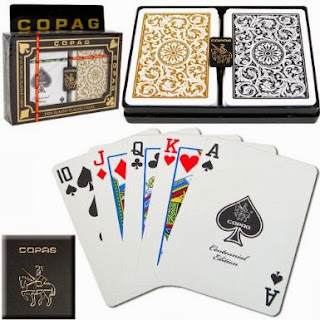
Cards: Ages 3+, 1 to any number of players

Decks of cards, whether they are the well known Western type with 52 cards in 4 suits, or special European or Asian decks, are a great starting point for any number of wonderful games, including Bridge, Hearts, Skat, Cribbage, Pinochle, Oh Hell, Bullsh*t, Durak, President, Spades, Solitaire, and many others.

Check out Pagat.com for the rules to these games and to thousands of others.
Codenames: Ages 10+, 4-10 players

Codenames is a new, fun game that uses words in an unusual way. Two teams, the clue givers alternate trying to give one word clues that match as many of their team's cards as possible. You must find a word that matches multiple other words, but not any of your opponent's words or the assassin's word. It's mindbending, and the game is infinitely replayable.

A great game for non-gamers and gamers alike.

Dixit: Ages 10+, 3-6 (12) players

Dixit is an incredible game, especially for non-gamers. It is loved as a creative exercise: pick a card and give a word, phrase, song, dance, or any other clue to describe it, but not too perfectly. The other players try to play cards that also match your clue. You only get points if some people guess which was your card and some people don't.

The fun is in the creativity of the clues, and I've yet to see a game where even the most stodgy non-gamer doesn't have fun.

There are now several expansions, which are all good. This game, like many others, was inspired by Apples to Apples, another nifty game for the casual non-gamers who walk among us.
Froggy Boogie: Ages 3-9, 2 to 4 players

Froggy Boogie is a brilliant game to frustrate grownups and please younger children. All you have to do is remember where the picture of the fly is, under the left eye or the right eye? The dice have only colors - no counting necessary. It's a perfect first game.
Go / Pente: Ages 6+, 2 players

Beyond Chess, Checkers, or XiangQi is the absolute perfect game of Go (aka Weiqi); it's so popular, there are twenty-four hour television stations dedicated to it, an anime series based on it, and it's considered one of the four arts of the Chinese scholar.

It really is that good, and the rules are easy, too. Best of all, a built-in handicap system allows two people of any skill levels to enjoy a challenging game against each other.

You should play with the nicest board you can afford.

Pente, a game of getting five stones in a row, can be played on the same board. The rules are just as easy as Go, and while the game has much less depth, it is also a little less intimidating to new players.
Jungle Speed: Ages 8+, 3 to 8 players

There are several games of speed reaction / pattern recognition on the market; I chose this one because of the components. Players flip cards in turn and grab for the totem in the middle as soon as two matching cards are revealed. Don't play with friends who have sharp nails or finger jewelry.

Love Letter: Age 8+, 2-4 players

This game has just 16 cards, but it packs a full, replayable deduction, bluffing game into 10 minutes. It's a top seller, takes 30 seconds to learn, and is challenging to play.

It's not my type of game, but I'm in the minority.
Magic the Gathering: Ages 8+, 2 players

After two decades, Magic is still The Bomb when it comes to collectible card games, although Yu-Gi-Oh sells more cards. These are not easy games to learn, but quick start guides can get you off the ground fairly quickly, and then you have months and years of challenging game play ahead of you.

Don't get sucked into having to buy endless amounts of boosters; to play the game outside of a tournament, you only need a few hundred common cards which can be picked up for a penny each on various sites.
Mancala: Ages 5+, 2 players

This is widely known around the world under various names (e.g. Oware), and the national game of many African countries.

The rules are easy: pick up all the seeds in one of your bowls and place one in each bowl around the table. If you land on an empty space on your side, you win the seed and any seeds opposite.

There are a few more rules, but that's about it. It takes a few games to get up to speed; early victories tend to be lopsided. Once you get the hang of it, you can play several, quick, challenging games in succession.
Memory: Ages 3 to 12, 2 to 5 players

This is a first game for kids and adults, and a great game for it, because kids get the hang of it very quickly and adults find it a real challenge without having to pretend. All you need are one or two decks of cards, but an infinite number of these games are sold with various different pictures and themes.

You can play with more than 5 players, but I wouldn't recommend it.
Nefarious: Ages 8+, 2 to 6 players

This is a game of mad scientists that is great for 2 to 6 players, and doesn't sacrifice speed with more players. Each round, you select one of four actions. collect money from any neighbors who selected actions that your minions are invested in, perform your action, and then check to see if you won. The actions are: invest minions, play cards, take cards, or take money.

The cards are fun and the game is quick and replayable, because, in each game, you play with some random twists that make that game's experience unique.
No Thanks: Ages 7+, 3 to 5 players

This is an easy to learn and addictive little card game. A card is flipped up, and you either take the card and any tokens on it or place one of your tokens on it and pass it to the next player. Cards are bad, and tokens are good. But runs of cards only penalize you for the lowest valued card.

A simple and fun game.

Pandemic / Pandemic Legacy

Cooperative games used to be either very boring, very childish, or very hippy. A new breed of cooperative games are nail-bitingly challenging and fun.

Pandemic is a cooperative game of saving the world from disease. Other cooperative games include Lord of the Rings, Shadows Over Camelot, and the much simpler Forbidden Island.

The new Pandemic Legacy (like Risk Legacy, mentioned above), is a version that plays out: each time you play the world is permanently changed with stickers and torn cards; after dozens of plays, the game is over.
Poker: Ages 6+, 2 to any number of players

Playing for money is not a good habit, but a nice set of poker chips and some decks of cards is a great way to spend an evening. There are countless poker games, too.
Scrabble: Ages 8+, 2 (or 2 to 4) players.

Scrabble purists will tell you that you should only play with 2 players and a Chess clock, but for casual purposes it can be played with up to four. It is The word game, and for a good reason.

My favorite way to play is to ditch the board and just play Anagrams: turn over tiles, and first to call a word gets it. A similar, recommended game is Bananagrams, where players race to create their own crossword boards.
Set: Ages 6+, 2 to 10 players

Those who don't have it won't enjoy it. For those who do, it hits just the right spot in the brain. All you have to do is call out matches when you see them, but the matches have to match or not match in all four characteristics.
Stratego: Ages 6 to 15, 2 players

By the time I was in my teens, I had outgrown this, but it remains a seminal game for early players, a great introductory war game with all the basic elements: strategy, tactics, and bluffing. Avoid the electronic ones; they break and they're noisy.

Splendor: Ages 8+, 2 to 5 players

The new game on this list, this is a little resource management game of taking jewels and buying trade routes (i.e. cards). The components and decisions are few and pretty, and there are a few options for strategy, but they are well balanced, making this a tight game every time.

Very simple to understand, challenging to win.
Ticket To Ride: Ages 8+, 2 to 5 players

Many of my fellow bloggers think that this, rather than Catan, is The Game. I used to disagree, but I think I have come around. New players will find this a great intro game, with lots of choices and great game play.

There are several editions of the game, and the 1910 expansion is recommended.
Tichu: Ages 8+, 4 players

A partnership "ladder" game, similar to the game President (sometimes known by its crude name). It's similar, but the addition of a few special cards, a partnership, and passing elevate this to a perfect game for two couples. This is THE card game in gamer circles, and it's not at all complicated.
Time's Up: Ages 8+, 4 to 10 players

This consistently ranks as the number one party game on all of my fellow bloggers' lists. It's the number one ranked party game on Board Game Geek. Which says something.

It plays a lot like the parlor game Celebrities.
Uno: Ages 6 to 12, 2 to 8 players

This could be a child's second game, after Memory, and before moving on to real games. There's not much in the way of thinking involved, but its simple rules, portability, and quick play make it an ideal game for younger kids in almost any situation.

Just be sure to move up to better games when the kids are ready.
Wits and Wagers / Balderdash: Ages 8+, 4+ players

These are party trivia games where knowledge of trivia is not so important. The question is asked, and each player writes down an answer. These are revealed and players then bid on the answers they think are best. The winning answer, and the winning bids, all score points.

Wits and Wagers does this in the form of a poker game setting, while Balderdash requires you to make up funny possible answers. Both have won awards and acclaim as an order of magnitude better than you-know-which famous trivia game.
Zooloretto: Ages 8+, 2 to 5 players

Winner of dozens of awards, Zooloretto is a cute game for kids and decent game for adults. Simply take the animals as they are revealed from the deck and try to fit them into your zoo without overcrowding.

A few extra rules and some clever mechanisms makes the game enjoyable for all ages.


Enjoy,
Yehuda

Episode 18: Threes Company Is Live!

Posted on 5:14 PM by Tina

Episode 18: Threes Company is live!

https://soundcloud.com/user-989538417/episode-18-threes-company

We talk with John Siewenie of Picoarmor about small scale gaming.

The Veteran Wargamer is brought to you by King's Hobbies and Games.

https://www.kingshobbiesandgames.com/

Special Artizan Service Miniatures
https://www.facebook.com/Special-Artizan-Service-Miniatures-1791793644366746/

Picoarmor links:
http://Picoarmor.com

Twitter @socialpicoarmor

https://www.facebook.com/picoarmor/

Other companies we mentioned:
Oddzial Osmy
https://www.facebook.com/oddzial.osmy/

Blitzkrieg Commander
Cold War Commander
Future War Commander
http://www.blitzkrieg-commander.com/

GHQ
http://www.ghqmodels.com/

Soviet Army FMs
https://fas.org/irp/doddir/army/fm100-2-1.pdf
https://fas.org/irp/doddir/army/fm100-2-2.pdf
https://fas.org/irp/doddir/army/fm100-2-3.pdf

Central Front
https://boardgamegeek.com/boardgamefamily/4255/central-front-series

Panzer Korps
https://boardgamegeek.com/boardgame/16323/panzer-korps

Advanced Squad Leader
http://www.multimanpublishing.com/Products/tabid/58/CategoryID/4/Default.aspx

Panzer Blitz
https://boardgamegeek.com/boardgame/2238/panzerblitz

Rock-Con
https://www.facebook.com/groups/93980714283/

Kingmaker
https://boardgamegeek.com/boardgame/987/kingmaker

Winter War
http://www.winterwar.org/

Diplomacy
https://boardgamegeek.com/boardgame/483/diplomacy

I Ain't Been Shot, Mum
http://toofatlardies.co.uk/product-category/i-ain%C2%92t-been-shot-mum/

Team Yankee (Battlefront)
http://www.team-yankee.com/

Baccus 6mm
https://www.baccus6mm.com/

Games Plus
http://www.games-plus.com/

Historicon
http://hmgs.site-ym.com/?page=HconHome

Aepticon
http://www.adepticon.org/

Team Yankee (Audible)
https://www.audible.com/pd/Fiction/Team-Yankee-Audiobook/B01LXT7NLS

Red Storm Rising (Audible)
https://www.audible.com/pd/Mysteries-Thrillers/Red-Storm-Rising-Audiobook/B004D5K3LE?qid=1496350535&sr=1-1

Music courtesy bensound.com. Recorded with zencastr.com. Edited with Audacity. Make your town beautiful; get a haircut.


Independent games publisher Versus Evil and developer Obsidian Entertainment today announced that Pillars of Eternity II: Deadfire - Ultimate Edition is now available on Xbox One and PlayStation 4, with a Nintendo Switch version following later in the year. Originally released for PC and Mac, Deadfire received universal critical acclaim and picked up numerous awards.


Priced at $59.99, Pillars of Eternity II: Deadfire - Ultimate Edition features all the major updates and expansions available for the PC version made up of Beast of Winter, Seeker, Slayer, Survivor and Forgotten Sanctum.

With an enormous open world to explore and comprehensive cast of characters, Pillars of Eternity II: Deadfire - Ultimate Edition builds on the foundation of classic tabletop gameplay more than ever before, providing players with a deeper single player RPG game experience with either Turn-Based Mode or Classic Real-Time with Pause.


Players on PlayStation 4 and Xbox One can now experience and craft their very own sprawling RPG adventure and explore the infinite possibilities that await them from detailed character customization to the individual meaningful choices they make in-game.

"Console gamers can fully immerse themselves in an RPG adventure of exploration and discovery in what will be one of the definitive tabletop role-playing experiences available in 2020," said Steve Escalante, General Manager of Versus Evil.


Consumers can digitally purchase the Pillars of Eternity II: Deadfire Ultimate Edition through the Microsoft Store and PlayStation Store fronts today. Deadfire is also available as a physical release from today in the form of a Standard Edition and the Ultimate Collector's Edition courtesy of THQ Nordic for Xbox One and PlayStation 4 at an SRP of €59.99 | $59.99 | £49.99 and €129.99 | $129.99 | £119.99, respectively. The Ultimate Collector's Edition will contain the following items.
  • Pillars of Eternity 2: Deadfire [including the 5.0 PC patch], and all DLCs: Beast of Winter, The Forgotten Sanctum, Seeker, Slayer, Survivor
  • 10"/25cm Od Nua Statue
  • Spacepig Keychain
  • Metal-optic 3D Sticker
  • Premium Box


I feel like we've seen that dragon before. Interesting logo for Sanctum (bottom right).
          
Might & Magic: The Lava Pits of Aznar
United States
Sanctum Software (developer and publisher)
Released 1983 for Apple II
Date Started: 27 February 2020
Date Ended: 29 February 2020
Total Hours: 6
Difficulty: Moderate-Hard (3.5/5)
Final Rating: (To come later)
Ranking at Time of Posting: (To come later)
     
This is an interesting but frustrating game, created three years before its more famous namesake debuted. It's so obscure that I can't imagine Might and Magic creator Jon Van Caneghem ever heard of it. A search today finds a couple file hosting sites, a MobyGames entry, and a single ad from a 1983 issue of Creative Computing. Sanctum Software (of Springfield, Virginia) seems to have existed only for this game, and I can find no trace of author Rick Hoover.

Aznar was one of many early-1980s attempts to mimic the tabletop RPG experience in a text-based computer game. Its approach is similar to the better-known Eamon (1980): the player creates a character which is stored on a "hub" disk. Once loaded from that disk, he can then set out on adventures in any number of "module" disks. Hoover only ever created one Might & Magic "module," but he clearly intended to create more.

There are some ways in which he accomplished his goal admirably. Aznar is much larger and longer than an Eamon adventure or even any of the Maces and Magic titles. It takes place in an interesting setting: a ruined fortress sitting atop a volcano. I was never able to find any documentation for the game (there's a lot of in-game documentation, but it's all about the mechanics), but the goal seems to be to find and defeat the High Lord of the fortress and retrieve his magic amulet. The fortress is a sprawling place, but with logical clusters of rooms forming living areas, a dungeon, and guard quarters, as well as places where the man-made parts of the fortress transition memorably to caverns and underground hot springs.
          
My map of the game (click to enlarge).
             
The game is a proper RPG and makes use of its character elements. During character creation, players choose the character's race (human, elf, dwarf, hobbit), alignment (chaotic, neutral, good, evil), and class (warrior, wizard, and thief). Of these choices, the class is the most important. Each comes with a set of skills or (in the case of the wizard) spells that will see them through the adventure and must be used judiciously. Each class has its own way of navigating through the dungeon and solving puzzles, much like the later Quest for Glory series. So where a thief might pick a lock, a wizard will cast "Open Lock" and a warrior will just smash the door. But one thing I like is that warriors are not just unnuanced brutes. They have their own set of skills--"Power Leap," "Tower of Will," "Battle Lust," and "Death Blow" (as well as the aforementioned "Smash")--to employ at the right times.
           
Character creation.
          
The character's race matters less often, but it does matter. Elves and dwarves are alerted to some traps, for instance, and hobbits avoid damage that some other characters take. On studying the code, I don't think that alignment matters at all. Of the four attributes (strength, dexterity, wisdom, and charisma), I'm not sure charisma is ever called into play, but it's possible (I think) to create a character so dumb he can't even read, which blocks several parts of the dungeon and may even prevent winning.
        
The wizard gets across a lava pit in his own way.
       
The game also has a more advanced combat system than most text-based RPGs of the era. The game brings up your enemy's statistics along with your own and asks what type of attack you want to make. You either enter the name of a weapon or a special type of action like BACK STAB (for thieves), DEATH BLOW (for warriors), or BURNING HANDS (for wizards). Each class has to be careful about over-using skills during combat because they have a limited number of "class points" and need to save as many as possible for puzzles. You get experience for combat and solving puzzles, and you level up several times during the adventure. There are also (trivial) considerations of food and sleep.
         
Doing battle with an ogre.
           
Unfortunately, the game undoes itself with a horrible approach to its parser. I'm going to assume that it came with a document explaining the most common commands and thus forgive it for making me figure so much out on my own, but even then there are lots of problems. I'm no programmer, but my sense of most text-based games is that the commands are independent from the immediate situation. So if you're playing Zork, for instance, the game recognizes GET LAMP as a valid command even if there's no lamp in the area. It then feeds you back a context-specific error message like "there is no lamp here."

What Mr. Hoover seems to have done is to define the list of valid commands for each room at the moment that you're in the room. Thus, if you type OPEN DOOR in a room that has a door, no problem--the author anticipated that. But if you type OPEN DOOR anywhere else, the game has no idea what you're talking about, and you get a generic error message ("I do not understand this") as if you'd typed gibberish.
            
I'm in front of a golden door. I have a golden key. It shouldn't be this hard.
            
What makes this approach particularly infuriating is that the author wasn't consistent in his anticipation of commands. Sometimes the room is waiting for you to type LOOK, sometimes EXAMINE, and sometimes SEARCH. There are times that the verb is enough and other times where you have to specify a particular object. This is particularly annoying in places where the game didn't even bother to highlight the object in the description of the room, or even mention it. There's a hallway where, in order to get a password to a later room, you have to SEARCH WALL even though every room has walls and there's nothing special about this one's. There's a room where you have to SEARCH OGRE to get a set of keys, but the game didn't bother to tell you that the dead ogre is in front of you. There are a couple of rooms in which you have to intuit that LEAVE is the way out despite the command not being used anywhere else. I had to inspect the game's code when I was stuck in some of these situations.

Another oddity is that there is no sense of permanence. You can't drop objects, for instance, and the game just adds most items you find to your inventory automatically. It's common for the game to immediately transition you to the next room when you find a secret door or pick a lock, but when you return to the original room, the door is hidden and the lock locked again. Although it's generally good about remembering that you already killed certain monsters, there are a couple of rooms in which you can type ATTACK repeatedly to fight the same monsters indefinitely.

And then we have the spelling. While most of the text is well-written, it is peppered with the occasional howler of an error, as when in the instructions the author seems to think the singular form of THIEVES is THIEVE. Even worse is when you have to deliberately misspell what you want to do. A thief has to SNEEK throughout the game, and if you want to find the 300 gold pieces hidden at the bottom of the COULDRON, you'd better spell it that way.
            
A misspelling mars an otherwise decent description of a torture chamber.
        
The game begins at the locked door to the fortress, where right away the character has to use his skills or spells to get in. A bridge crosses a moat of lava on the other side, and a dexterity check determines if the character makes it across (with a loss of hit points) or dies immediately in molten rock. A trap must be disarmed on the next door or else the player experiences another instant death. In the fourth room, he has a limited amount of time to search it (for an orc sword and a note) and to reach the attic (for some gold, a battle with a stirge, and a golden key necessary to exit the fortress later) before the room collapses. If he gets out before it collapses, he finds himself in a hallway with no way to get back to the entrance, and things are quite a bit less deadly from then on. There are only a few instant deaths and the player can save anywhere.
          
An early room.
             
The main part of the fortress has some memorable encounters:
           
  • A group of half-orc guards drunk on ale in a storeroom. One of them is sober enough to fight and must be defeated. In an alcove of the room, the player discovers a troll feasting on one of the half-orcs and must kill it, too.
  • A watery cave with a broken sword in the water. If the player tries to investigate the sword, a slime drops on him from above and must be defeated.
  • A waste room with a plank crossing it. Careful players must find a quiet way to cross; otherwise, an otyugh erupts from the water and does battle.
  • There's a magic sword called "Ewansil" and a suit of leather armor hidden among a pile of bones in a fountain room.
  • If the player enters a kitchen, the terrified staff jumps down a trash "shoot" to escape him. If the player follows them down the "shoot," he finds (fatally) that it goes directly into a lake of lava. I guess he was so scary that the staff was willing to commit suicide.
  • Entering a small cave, the player finds a bunch of statues of previous adventurers in realistic, lifelike poses. He has only a moment to think "uh-oh" before he's attacked by a basilisk. The creature gets very favorable rolls with its gaze attack and is tough to defeat.
          
That's never a good sign.
          
In a "great hall" upstairs, the player finds a secret door in a fireplace. This goes to a series of tunnels that end in a cell in the dungeon. (There are prisoners, but they're all mute and insane from torture.) Searching the other cells results in getting surprised by an ogre and tossed back into jail, so after it happens for the first time, you have to pre-emptively ATTACK the ogre the next time, get his cell keys, open up the sixth cell, and get a hint to use the magic word ELWENTHRAL when stuck on the water.

Later, in a lower area, some stones cross a boiling underground lake and lead to the treasure chamber, where the player loots 500 gold pieces. (There are other opportunities to get smaller amounts throughout the fortress, but no place to spend it.) Using the magic word produces the boat, which the player can then sail downriver to a hydra's lair. I think this was supposed to produce a hydra, but the game was bugged and no command worked while in the lair, so I just left. You then have to climb down a well, and go through some other passages.
            
Summoning a magic boat.
          
There's a secret door that only opens with a password; a set of runes only tells you to "speak the word" to open the door. You can spend a frustrating hour trying to figure out what the word could possibly be, or you can remember your "obvious clues" in cryptic crosswords and realize that what you want to say is literally THE WORD.

Later, there's another room where you're asked a password, and you've had to search a wall to find that the "gambler's password is look backwards." But it's not LOOK BACKWARDS; it's LOOK, backwards, or KOOL.

You pass through a room with a genie by just giving him your real name and defeat a two-headed troll in a "shaft room." Climbing down the shaft puts you in a cool cavern, and this is where my game ends. There's something bugged in the program that prevents the command prompt from loading in the cavern, so the game just hangs.
            
The last screen that I can experience.
            
However, I can tell from the game file that I'm very near the end. I'm supposed to search the cavern to find a wight, kill it, then search again to find a trap door in the floor. This leads to an encounter with the High Lord. Killing him lets you take his amulet, and the gold key found very early in the game (pity the player who didn't think to type SEARCH in the attic) opens the doorway out. The fortress rumbles and crumbles behind the player as he switches back to the "genesis" disk to save his progress. I was so close I'm going to call it a win, though if someone who knows more about what they're doing wants to fiddle with the code, I wouldn't mind seeing if there was a final graphic or something.

My character aged six years in the dungeon, and judging by the code, it's possible for you to spend so long trying to solve the game that the character literally dies of old age.
             
My character towards the end of the game.
           
Without the ability to at least scan the text in the code, I wouldn't have gotten very far in the game--the parser would have defeated me--and in the day, I would have felt that the game's advertised price of $39.95 was absurd. I presume other players felt the same way, which is why we never saw a second adventure.
            
The game has an okay combat system, but the "most advanced combat system" might be pushing things.
          
Aznar gets a 18 on my GIMLET, doing best in "gameplay" (4) for its modest length and replayability, "character development" (3) for the way it actually uses the character during the game, and "magic and combat" (3) primarily for the use of magic in puzzle-solving as well as a few combat tactics. It has no NPCs and no economy, and I set "graphics, sound, and interface" to 0 since it has no graphics or sound and the interface is punishing. (I normally wouldn't punish a text-based game for a lack of graphics and would have given it at least a 1 if the text hadn't been full of errors and the parser hadn't been a nightmare.)
           
My final battle, against a two-headed troll.

        
This is certainly one of the last text-RPG hybrids that we'll see. It's interesting how so many of these games didn't quite come out right despite (presumably) the greater ease in programming a non-graphic game. I think a truly excellent text-RPG hybrid, fully evoking the experience of a tabletop gaming session, is possible, but I suspect we'll never see it.